web analytics

Education Fast Forward Debate – number 4

A very stimulating EFF debate about Innovation, Learning and Uncertainty  took place on 18th April 2012. The event was hosted by Cisco at 15 of its Telepresence rooms and on this occassion included one external room at the University of Virgina.

The debate was organised by Education Fast Forward which aims to bring together global experts and change experts from around the world to discuss the topics that matter most.

The event was simultainiously broadcast by Cisco TV on a Ustream.tv channel where the recording will be available for viewing again soon.  The recoding was published overnight on 24th March  and can be viewed here

http://www.ustream.tv/recorded/22097512

There was in parallel a very busy Twitter conversation which has been archived for viewing here.

http://storify.com/tonyparkin/effdebate-april-2012-innovation-gaming-and-neuros

Tony Parkin was responisible for posting tweets about the event as it proceeded and he kindly provided  the above Storify archive of the twitter activity for the last 90 minutes of the event.

I was most intersting to see how the debate continued into the evening on twitter long after the formal session (lasting 2 hours) had ended.  Much of the conversation in Twitter centred around the use of games in the classroom.

It seems to me that a great deal of great work was done in Scotland led by Derek Robertson (he was listening in and commented on Twitter) through his work at the Consolarium which was setup at Education Scotland ( Learning and teaching Scotland at the time).  For those interested in “games based learning” the linked site above is definitley  worth a browse.  The Consolarium led by Derek was a real hotbed of innovation – but seems to have been constrained somewhat recently.

The next EFF debate is scheduled to take place on the 10th July 2012 with the topic “Peace one day” so do keep an eye on the EFF web page for updates about the topic and precise timing.

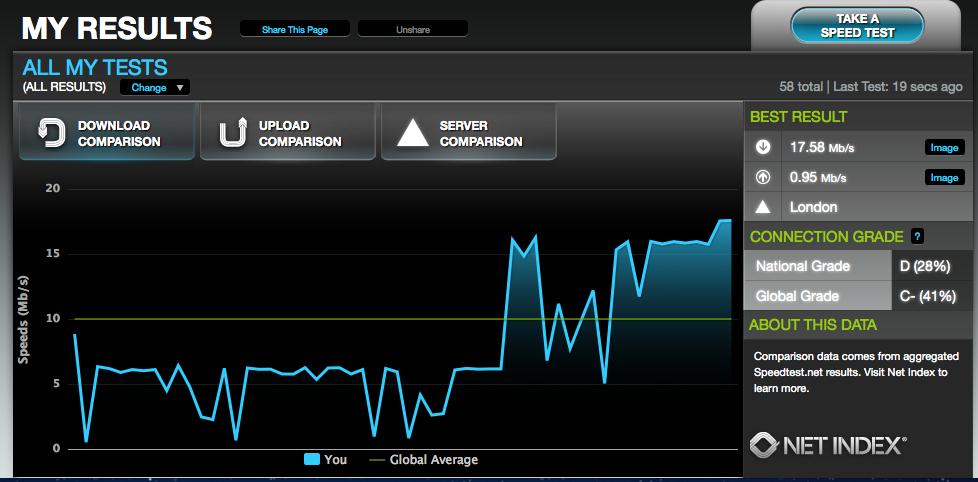


BroadBand Speeds in Kemnay

Since my broadband service was upgraded from ADSL to ADSL 2 I am benefiting with much improved performance.  The following graph shows a summary of my recent speed tests and clearly show the improvement from before to after.

It is clear to see a period of unstability – BT say that they take a few days to tune the service to get the best possible performance.  The is one glitch  which happened two days ago where perormance when to about 1 Mbps on the down link…….  That was dissappointing – but a BT HomeHUB reboot seemed to fix the issues.  I am reasonably pleased so far.  Although not clear from the graph the upload speed seems to have setteled in at around .95Mbps which is the main benefit for the sort of applications I need to support from my home office.

I tested the new link by conducting a High Definition TP call from my desktop to a colleagues in Washing DC when the audio and video quality was quite stunning for sure and definitely a vast improvment on what was possible prior to the upgrade.

Summary Results from Speedtest before and after ADSL 2 upgrade


http://www.speedtest.net/results.php?sh=a07374f9a4772a82c607d55c9d620aec&ria=0

BYOD – its happening where I work! #EDUScotICT

I posted some time ago concerning the provision of support for pupils and teachers to “bring their own devices” see http://www.ruachonline.org.uk/blog/?p=466 if you want to read what I said.

Today, I was reading some information about the support for BYOD that my own company provides to allow its employees to bring their own devices and connect them to the Corporate network.  My company is of course very concerned about the security and integrity of it network which spans the world.  I can walk into any Cisco office in any country and gain access to the building by swiping my ID badge on an RFID sensor and then gain access to the Cisco Network by either connecting to the wired or wireless network.  In the latter case I do have to enter my user credentials before access is premitted.  I can do this using my Cisco provided laptop or using my iPad!!!!  The latter is a presonal device and is not funded/provided by Cisco.

So here is a summary of the statistics for the last calendar year!

  • 50k users of mobile devices
  • Growth spurt in the last year with an increase or 52%
  • employees are purchasing their own devices including iPhones and iPads
  • 10% growth of iPad use to a current total of 8,000

Read the source post for this which provides some further data at http://blogs.cisco.com/ciscoit/collaboration-is-hot-…-a-“bring-your-own-device”-mobility-update/

It seems to me that if a large corporation like Cisco is able and willing to support BOYD then this certainly provides a signal that this is an approach that could and should also be adopted by other organisations.

Is this a trend that we can ignore in Education?

Of course I do not mean to take the naive view that what is good for the corporate world is necessary best for the world of Education – but do feel that we do need to take a more open view on what is best to facilitate the best education for today’s learners.

Education decision making and policy making should always be driven by education objectives in my view.


The Knowledge Explosion continues

I wrote some weeks ago about the knowledge exoplosion – see the following post – click here to view.

This afternoon I stumbled into and open online lecture given by Steve Wheeler from Plymouth University – see his blog click here

During the course of his talk he used the slide below which graphically shows how much data is being added to the internet every 60 seconds.  Of course the vast majority of this will never be seen by most internet users, but it will be indexed by search engines and bits of it may pop-up in the most unexpected places.

Sadly, there is no guarentee that any one piece of this data will conform to any given standard of quality and accuracy – so it seems to me the one of the most important things that learners need to master is the art of discernment and validation.

The idea that it must be true because we saw it on the internet if of course a complete false hood.

but do reflect on the numbers below – quite mind bloggling I think!!!!!!!!!

This image was produced by Infographic by- GO-Gulf.com Web Design Company

Question is – do we believe the information presented below just because “we saw it on the intenet”  I do believe this because is seems to come from a reliable source!!!!